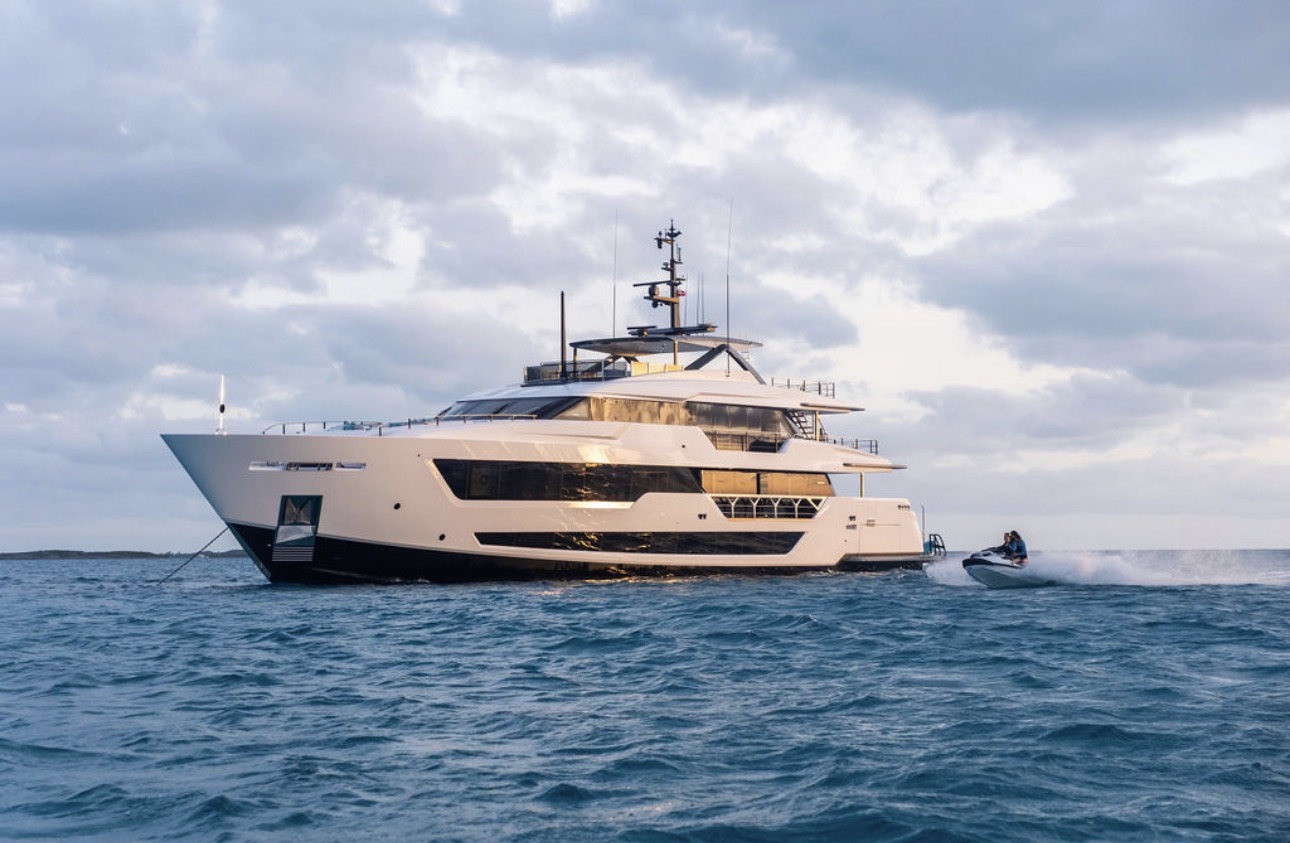
Can You Put a Real Gym on a Yacht Without It Taking Over the Deck?

Yes — but only if the equipment is designed to disappear the moment training's over. A dedicated gym room works on land because the room has a door. A yacht rooftop doesn't have that luxury: it's training space at 7am and it's the party by 7pm, in the same square footage. Get that wrong, and you've built a very expensive obstacle.
Here's how I know, because I got it wrong first.
01 / The Mistake
A client had a home gym that worked — real equipment, used daily, a layout he was happy with. So when we built out the rooftop of his 140-foot yacht, the plan was simple: give him the same setup, just afloat. We installed roughly $50,000 in equipment up top.
Then he took the boat to Europe.
First real trip, and the rooftop did exactly what a rooftop on a boat like that is supposed to do in the evening: it became the party. Cocktail hour, guests up top — and $50,000 of gym equipment sitting in the middle of it, in the way of every conversation. We rebuilt the whole thing before the next trip.
02 / What I Got Wrong
I'd designed for how the space would be used, but not for everything it would be used for. On land, a gym is a room with a door. On that deck, there was no door — training and entertaining had to share the exact same footprint, at different hours of the same day.
A layout that serves one use and ignores the other isn't a finished design. It's half of one.
03 / The Fix
Build the equipment into the furniture instead of placing furniture around the equipment. The rack, the bench, the storage — all of it now lives inside custom-built outdoor couches and loungers. Train in the morning; by evening it's a couch that seats three or four with drinks on it. Nobody at cocktail hour would guess what's underneath.
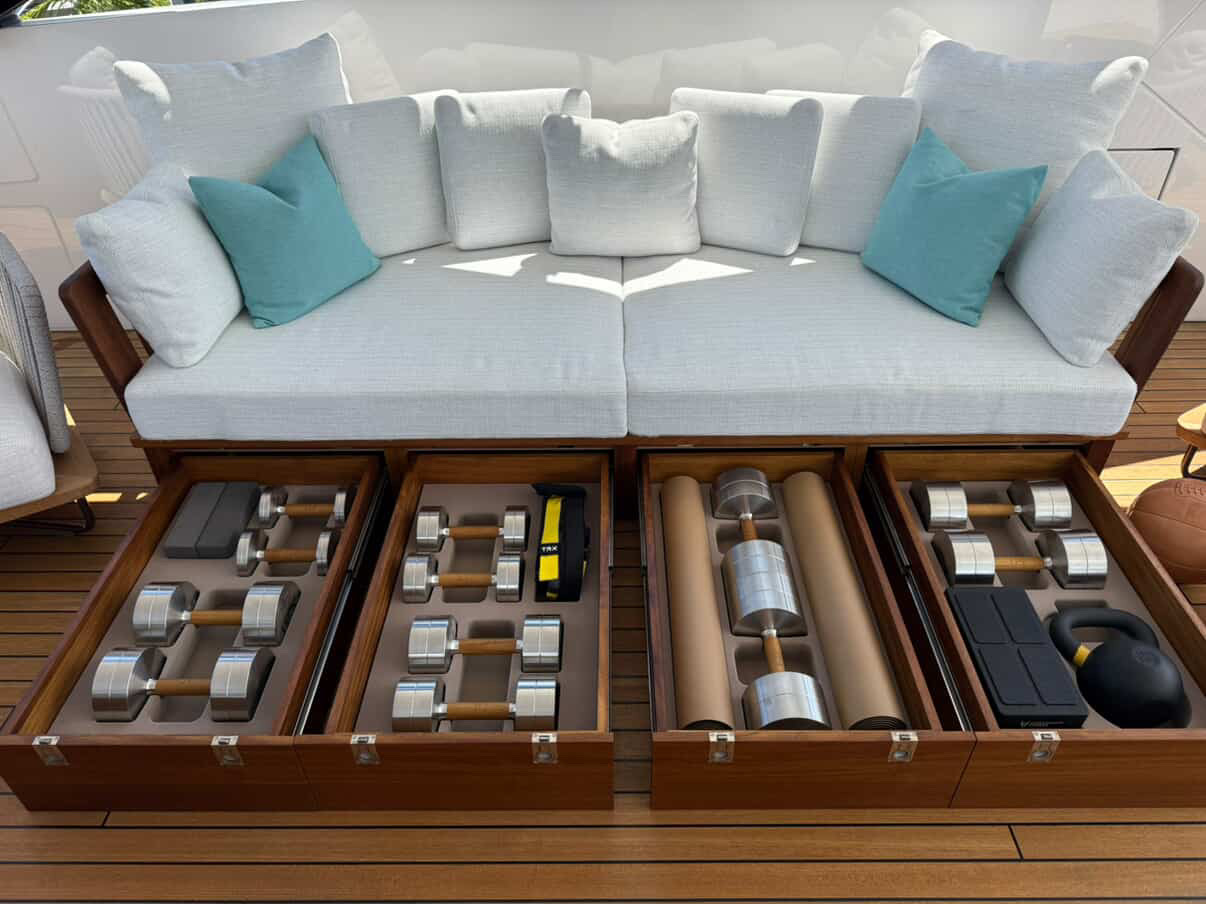
And because nothing needs to be moved, stored, or staged, crew never touch it. No setting up equipment before a session, no breaking it down and stowing it after, no gym gear competing with everything else on their list. It's ready, or it's hidden. There's no in-between state for anyone to manage.
What this means if you're planning a gym for your own yacht:
- Ask what else the space needs to be, and at what hour. A dedicated gym room below deck can just be a gym. A rooftop, a beach club, or any multi-use deck can't — design for the second use before you spec a single piece of equipment.
- Weight and placement are a naval architecture question before they're a fitness question. Equipment on an upper deck affects stability and structural load in ways a home gym never has to consider — this gets decided with your builder or naval architect, not after equipment is already ordered.
- Salt air changes what "good equipment" means. Corrosion-resistant frames, marine-grade upholstery, and finishes rated for humidity and salt exposure aren't optional upgrades on a yacht — standard commercial equipment will corrode faster than you'd expect.
- It should reduce crew workload, not add to it. Portable equipment means someone on crew is setting it up and breaking it down around every session and every guest changeover. Built-in equipment removes that job entirely.
- If it can't disappear when it's not in use, it's not finished — for any shared deck space, that's the actual test, not how it photographs mid-workout.
None of this is complicated. It's just not what gets pitched, because "equipment package" sells easier than "a space that has to do two jobs at once."
But if you want the gym to actually get used and never get in the way, this is the whole game: design for the room's second life, not just its first.
FAQ
How much deck space does a real yacht gym need?
Enough for one full range-of-motion lift — typically a 6x8ft footprint minimum — plus clearance to move around it. On a shared deck, plan the storage or disappearing mechanism into that footprint from day one, not as an afterthought.
Can gym equipment go on an upper deck without affecting the yacht's balance?
It can, but weight and placement need sign-off from the naval architect or builder before equipment is chosen. This is a structural conversation, not just a design one.
Does regular home gym equipment work on a yacht?
Not well for long. Salt air and humidity accelerate corrosion on standard frames and upholstery. Marine-rated equipment costs more upfront and outlasts standard gear by years.
Does the crew need to set up the gym before guests use it?
Not if it's designed correctly. Portable equipment requires crew to deploy and stow it around every use. Equipment built into the furniture itself needs none of that — it's either in active use or completely out of sight, with nobody's job attached to the transition.